We are preparing for ExpoDetergo 2026
Going deeper into the product, down to its very structure

For us, research and innovation are not about chasing new buzzwords. They mean understanding textiles better, studying them in greater depth and improving them in practical ways.
We do not stop at selecting raw materials or choosing yarns. We look closely at the fibre, the fabric, how it behaves during washing, the release of substances and its durability. This is also where science comes in: to help us understand more, control more effectively and develop increasingly reliable products for professional use. The research programme we funded together with the University of Rome Foro Italico in 2021 focused on innovative textiles, the reuse of natural fibres such as cotton and photocatalytic techniques applied to the sector.
Studying textiles, not just selling them
In our work, the product cannot be treated as a closed box. To be truly credible, we need to know what is inside a fabric, how it behaves over time, which performance levels it can maintain and which issues it may generate throughout the supply chain.
That is why we chose to invest in a structured research programme together with the Hygiene research group at the University of Rome Foro Italico, coordinated by Professor Vincenzo Romano Spica, with activities conducted by engineer Giusy Lofrano. It is a deliberate choice: to bring scientific expertise, analytical methods and a deeper understanding of textiles into the product development process.

From fibre to wastewater: the product is studied throughout its entire lifecycle
Our research works on several levels. On the one hand, it focuses on the durability and reusability of materials. On the other, it examines what happens during washing, with particular attention to process water, colour release, optical brighteners, fibres and the effects of wastewater on aquatic environments.
The first phase focused on coloured fabrics sold by the metre for table linen, assessing their impact during washing and drying cycles. The research then moved on to white fabrics, particularly towels and sheets, to analyse the release of contaminants and the behaviour of effluents generated during cotton washing.
Applied research, not just theory
This work is not intended to remain purely academic. It is designed to have practical effects on both the product and the sector.
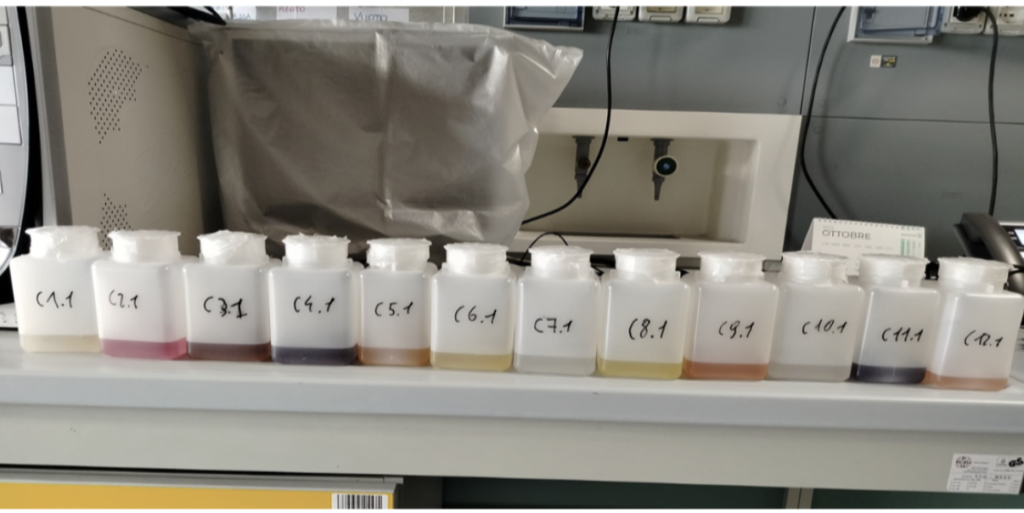
In tests on coloured table linen, 12 fabrics in different colours were selected and subjected to repeated washing and drying cycles; the water was then analysed for colour release, turbidity, total organic carbon and effects on target organisms. After 12 cycles, colour and turbidity had been reduced by 99%, while the observed toxicity decreased significantly between the first and the final wash.
In subsequent research on white fabrics, we examined optical brighteners, fibre release and effluent composition in greater depth, eventually testing innovative treatments for laundry wastewater using photocatalytic processes and engineered nanomaterials, achieving almost complete removal of the detected compounds and toxicity.
Innovation also means laboratory expertise
University research works alongside another investment that is strategic for us: the enhancement of our internal laboratory.
We have acquired a high-definition microscopy system to analyse fibres, yarns and fabric characteristics with greater precision. This tool helps us classify fibres more accurately, detect impurities and support quality control with a higher level of detail. In practical terms, it strengthens the connection between research, sample verification and product improvement.
Research focused on the future of professional textiles
For us, innovation does not mean moving away from the product. It means getting closer to it.
It means understanding materials better, studying how they respond to different processes, reading the signals that emerge from washing, and exploring natural fibres and technologies that can improve their use, reuse and performance. This is what allows us to approach the product with greater expertise rather than simply bringing it to market.
The purpose of this commitment is clear: to contribute to the development of professional textiles that are more advanced, better controlled and better equipped to meet the challenges of the coming years.
For those who work with us, this means something very tangible: knowing that behind every product there is not only commercial experience, but also research, verification, experimentation and a genuine commitment to improving what we offer.